Oregano oil benefits and safety
Oregano oil attracts attention for its plant compounds. Here is how to separate laboratory findings from claims about supplements.
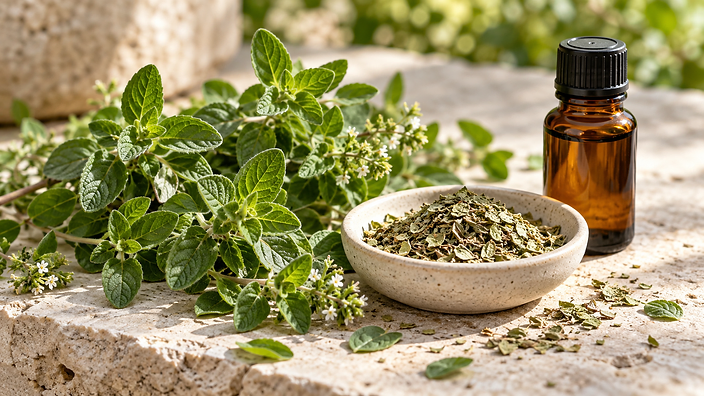
Fresh and dried oregano beside an unbranded amber bottle. AI-generated editorial illustration; not a photograph of the product sold by Wellness Herbs Plus.
Searching for oregano oil benefits often brings up a mix of practical information and dramatic promises. Before choosing a bottle, it helps to understand what researchers have studied and what a supplement label can actually tell you.
Oregano used in food, concentrated oregano extracts, and finished oregano oil softgels are different products. A claim about one preparation should not automatically be applied to another.
What is oil of oregano
Oregano contains compounds including carvacrol and thymol. These compounds help explain scientific interest in the plant. Concentrated oil preparations may be sold in capsules or liquid formulations, with different concentrations and ingredients.
The National Library of Medicine’s LiverTox entry on oregano explains that laboratory and animal findings have not established oregano oil as an effective treatment for human diseases.
That distinction matters when a headline calls a product a “natural antibiotic.” A laboratory result is not a reason to replace a prescribed medicine.
What to know about oregano oil benefits
Research interest is a starting point for asking better questions. When reading a claim, look for the actual preparation studied, whether people participated, and what outcome was measured.
For example, a study of an isolated compound does not establish that every softgel containing oregano will produce the same result. Nor does adding black seed oil prove that a finished blend is more effective than either ingredient alone.
Before relying on a claim, ask whether it concerns the exact product, an ingredient, or an entirely different preparation.
How to compare oregano oil softgels
Use the label to make a side-by-side comparison before looking at promotional language.
| Label detail | What to check |
|---|---|
| Serving size | Whether the stated amount applies to one softgel or several |
| Ingredient amount | Whether the figure describes actual extract or a stated herb equivalent |
| Carvacrol content | Whether an amount or percentage is disclosed |
| Added ingredients | What else is included in the blend |
| Capsule ingredients | Whether the shell and other ingredients fit your preferences |
A large front-label number needs context. Ask the seller to explain any “equivalent” amount rather than treating it as the weight of concentrated oregano oil in a capsule.
Keep a photo of the full label when comparing options. It is easier to compare the same fields than to remember several different marketing descriptions.
Oregano oil side effects and precautions
LiverTox notes that higher doses may cause stomach discomfort, heartburn, nausea, vomiting, or other adverse effects. Allergic reactions can occur. Concentrated oregano supplements should be avoided during pregnancy.
For breastfeeding, LactMed advises avoiding amounts above normal food use because safety information is lacking.
Ask a healthcare professional before using a concentrated botanical supplement if you take medicines or have a medical condition. A product being sold as “natural” does not establish that it is suitable for you.
Watch supplement and medication guidance
Dietary Supplements and Medications — U.S. Food and Drug Administration
General education about combining supplements and medicines. This is not an oregano-specific clinical video or a product endorsement. Official FDA source page.
Explore oregano oil with black seed oil
Wellness Herbs Plus offers Oregano Oil 6000mg Softgels with Black Seed Oil. Review the current label to understand the serving size, how the advertised amount is expressed, and the ingredients in the formula.
For another botanical ingredient guide, read Soursop Benefits and Safety. Compare each product on its own information rather than assuming botanical supplements are interchangeable.
Educational information only; not personalized medical advice. Dietary supplements are not intended to diagnose, treat, cure, or prevent disease.