Soursop Benefits and Safety: What to Know Before Trying Graviola
Explore soursop benefits, the limits of graviola research, safety concerns, medication considerations, and what to check before choosing a supplement.
Part 3 of the Wellness Herbs Plus ingredient series. Research reviewed October 17, 2026.
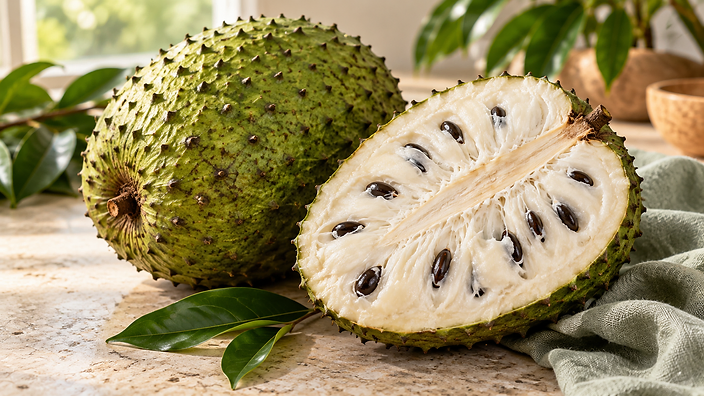
If you grew up eating soursop, you may know it first as a fruit: green on the outside, creamy inside, with a flavor that is sweet and pleasantly tart.
If you discovered it online, you may have met a very different version. Soursop appears in videos about immunity, inflammation, blood sugar, and serious illnesses, often with little explanation of what researchers actually tested.
There is a useful conversation to have about this plant. It begins with separating the fruit from the supplements—and the research from the promises.
What is soursop?
Soursop, also called graviola or guanabana, comes from the tree Annona muricata. Its pulp is eaten as food and used in drinks and desserts. Other parts of the plant have a history of traditional use.
Today, products sold under the soursop name may contain fruit powder, leaf material, extracts, or combinations of ingredients. That distinction matters. A food serving, a cup of leaf tea, and concentrated drops can expose you to different plant compounds in different amounts.
Before comparing benefits, ask a basic question: which part of the plant is in this product?
Why soursop attracts scientific interest
Researchers have investigated compounds in soursop, including a group called annonaceous acetogenins. Studies have explored antioxidant activity and effects on inflammation, microbes, and cancer cells.
Much of that work comes from laboratory or animal research. It helps scientists identify questions worth studying, but it cannot establish that taking a retail supplement produces the same effects in a person.
A substance can affect isolated cells and still prove ineffective, unsafe, or difficult to use as a treatment. The preparation, dose, absorption, and effects on healthy tissue all matter.
Traditional use provides context, too. It does not settle the questions that controlled human trials need to answer.
What do we actually know about soursop benefits?
The strongest answer is that research remains limited for the broad health benefits commonly advertised.
Claims about “immune support” or “inflammation” need specific evidence. Did participants have fewer infections? Did symptoms improve? Was a laboratory marker measured? Was the study testing soursop alone or a blend?
These are different outcomes.
NCCIH makes a related point about antioxidants generally: finding antioxidant activity does not establish that a supplement prevents chronic disease. Research on antioxidant supplements has often failed to reproduce the benefits associated with diets rich in fruits and vegetables.
For a shopper, the useful habit is to look past the headline and ask what changed in people—not simply what happened in a test tube.
The cancer claims deserve a clear answer
Soursop has not been established as a treatment or cure for cancer. It should not replace surgery, medicines, radiation, or other care recommended by an oncology team.
It is also inaccurate to say there has never been human research.
A small randomized study published in 2017 enrolled 30 people with colorectal cancer after removal of their primary tumor; 28 completed the trial. Participants received a leaf extract or placebo for eight weeks. One research outcome involved testing participants’ serum against colorectal cancer cell lines.
That is not the same as demonstrating that tumors shrank, cancer recurrence fell, or people lived longer.
Cancer Research UK concludes that there is not enough reliable evidence to support graviola as a cancer treatment. Someone undergoing cancer treatment should discuss any proposed soursop product with their oncology team before using it.
Soursop and heart health: promising claims need better evidence
Soursop is sometimes marketed for blood pressure or blood sugar. There are preclinical findings in these areas, but they do not establish it as a dependable treatment for hypertension or diabetes.
Memorial Sloan Kettering flags possible additive effects with medicines that lower blood pressure or blood sugar. Those concerns are based substantially on animal research, and their clinical importance in humans is not established.
That uncertainty cuts both ways: it does not justify a treatment claim, and it does not justify assuming a supplement is safe alongside your medicines.
Keep following your prescribed care plan. Ask your pharmacist to assess the complete product rather than making changes based on an ingredient’s reputation.
Why long-term safety deserves attention
Some soursop compounds have raised concerns about effects on the nervous system.
A risk assessment carried out through the EFSA-supported EU-FORA program found substantial uncertainty around soursop supplements. It identified indications of neurotoxic potential in certain preparations and concluded that the available evidence could not establish a safe intake level.
There is newer research as well. A 2026 study compared people with Parkinson’s disease in the Caribbean and mainland France. The Caribbean group, in which exposure to Annonaceae fruits was common, had more severe motor and cognitive symptoms.
This was a comparison between groups, not a randomized feeding study. It cannot prove that soursop caused the differences, isolate one product’s effects, or establish a safe dose.
It does add to the reasons for caution, particularly for people with Parkinson’s disease or other movement disorders. Discuss soursop with your neurologist rather than starting a concentrated product on your own.
Fruit, tea, capsules, and drops: read the distinction
| Form | What to check |
|---|---|
| Fruit or fruit pulp | This is a food use, which should not be treated as equivalent to a concentrated supplement. |
| Leaf tea | The amount extracted can vary with the material, preparation, and brewing method. |
| Capsules or powders | Identify the plant part, amount per serving, and whether the ingredient is an extract. |
| Liquid drops | Check concentration, serving size, plant part, and every additional ingredient. |
“Liquid” describes a format. It does not establish better absorption, stronger clinical results, or greater safety.

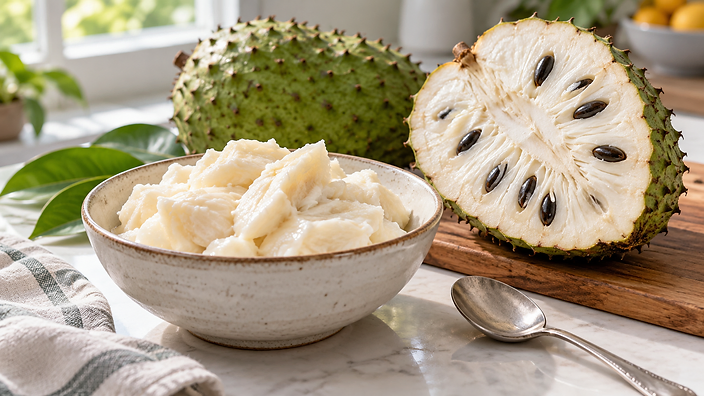
Product consistency is another consideration. A 2023 analysis of seven commercially available soursop leaf products found variation in annonacin content and other quality measures. That small sample cannot represent every brand, but it illustrates why products sharing a plant name should not automatically be considered interchangeable.
The study did not evaluate Wellness Herbs Plus products.
Exploring a soursop product at Wellness Herbs Plus
Wellness Herbs Plus offers a soursop-containing herbal liquid blend.
Use the product page to review the current formula, then check the bottle’s complete Supplement Facts panel and directions. Before deciding, look for:
- The part of the soursop plant used.
- The amount supplied in each serving.
- Whether that amount is individually disclosed or part of a blend.
- Other ingredients that overlap with supplements you already take.
- Available quality-testing information.
Because this is a multi-ingredient product, research on one ingredient does not establish the benefits or safety of the finished blend.
A product link makes it easier to examine your options. It should not be read as a claim that the formula treats the conditions discussed in this article.
Who should seek professional advice before use?
A medication and health-history review is especially important if you:
- Take medicines for diabetes or high blood pressure.
- Have Parkinson’s disease or another neurological condition.
- Are receiving cancer treatment.
- Are pregnant, breastfeeding, or considering a supplement for a child.
- Have surgery or medical imaging scheduled.
Tell the care team exactly what you use. Memorial Sloan Kettering flags possible effects on nuclear imaging based on animal findings; let the imaging team decide what needs to be paused and when.
NCCIH also notes that many supplements have not been tested in pregnant or breastfeeding people or children. An absence of safety data should not be treated as reassurance.
Common questions about soursop
Is graviola the same as soursop?
They are common names for the same plant, Annona muricata. Products can still differ in the plant part and preparation they contain.
Is soursop tea safer than capsules?
There is not enough reliable evidence to make that blanket claim. Tea strength varies, and a homemade preparation does not automatically provide a known or safe exposure.
How much soursop should I take daily?
There is no well-established, evidence-based dose for general wellness or disease prevention, and long-term safety remains uncertain. A label’s serving direction is not proof of an established safe intake level.
Can soursop cure cancer?
No reliable clinical evidence establishes it as a cancer cure. Do not replace or delay oncology care to try soursop.
Are drops better than fruit?
They serve different purposes. A concentrated blend should not be treated as a nutritional substitute for fruit, and no general superiority claim is justified.
A more useful way to approach soursop
You can respect a plant’s traditional history while asking careful questions about modern supplements.
With soursop, those questions are important: What plant part is used? What amount does the serving provide? What benefit has actually been demonstrated? What do we know about repeated use?
If you are exploring the soursop liquid blend at Wellness Herbs Plus, review the full formula with a qualified healthcare professional. Good product information should help you make a considered choice, including recognizing when an ingredient may not suit you.
This article provides general education, not personal medical advice. Dietary supplements are not intended to diagnose, treat, cure, or prevent disease.
Sources and further reading
- Memorial Sloan Kettering: Graviola
- Cancer Research UK: Graviola (soursop)
- NCCIH: Antioxidant Supplements—What You Need To Know
- The effect of an Annona muricata leaf extract on nutritional status and cytotoxicity in colorectal cancer: a randomized controlled trial (2017)
- Risk assessment regarding the use of Annona muricata in food supplements (2020)
- The Clinical Effect of Annonaceae Fruit Consumption on Caribbean Parkinson’s Disease Severity (2026)
- An evaluation of the quality of Annona muricata leaf products (2023)
- NCCIH: Using Dietary Supplements Wisely