Liquid supplements versus capsules and softgels
The most useful supplement comparison begins with the ingredients and amount per serving, followed by the format that fits your routine.
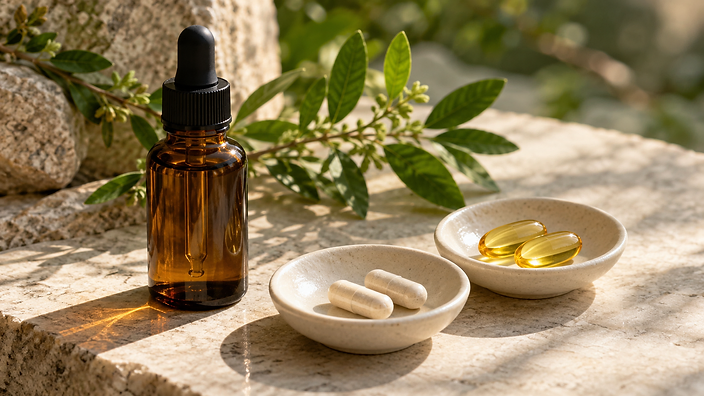
Liquid drops, capsules, and softgels shown as supplement formats. AI-generated editorial illustration; the items do not represent specific products or equivalent doses.
Liquid drops, capsules, or softgels—which supplement format should you choose? The answer starts with the ingredients and amount per serving. After that, consider how you would use the product in everyday life.
A format tells you how a supplement is supplied. It does not, by itself, establish how well the finished product works for a particular purpose.
Start with a fair comparison
The FDA lists liquids, capsules, and softgels among the many forms dietary supplements can take. Two products in different formats may also contain different ingredients or amounts, making a simple “which is better” comparison misleading.
Before comparing bottles, write down the ingredient you want to compare. Then identify the amount in one labeled serving of each product. If the preparations differ, note that difference instead of treating the numbers as interchangeable.
Liquid herbal supplements
Liquid supplements may appeal to someone who prefers a measured liquid to swallowing a capsule. Read the directions carefully: a serving expressed in milliliters should not be assumed to mean an entire dropper, and an unspecified “dropperful” should not be guessed.
Check the measuring instructions, taste preferences, storage directions, and other ingredients. If the label does not explain how to measure a serving, ask the seller before using it.
Capsules and softgels
For capsules or softgels, check the number of units per serving. A bottle containing 120 capsules does not necessarily provide 120 servings.
Also review the shell and other ingredients if you have dietary preferences or allergies. Avoid opening, crushing, or modifying a product unless its directions or a pharmacist confirms that is appropriate.
| Practical question | Liquid drops | Capsules and softgels |
|---|---|---|
| How is a serving measured? | Follow the labeled liquid measurement | Count the labeled number of units |
| What should I compare? | Ingredient amount per serving | Ingredient amount per serving |
| What affects convenience? | Measuring method, taste, and storage | Number of units and swallowing preference |
| How do I compare value? | Cost per labeled serving | Cost per labeled serving |
Are liquid supplements absorbed better
The bottle format alone cannot establish that one product is better absorbed or more beneficial. Ingredient form matters too: for example, NIH’s magnesium guidance compares absorption between specific magnesium compounds.
Look for evidence about the ingredient and formulation being discussed. Claims that liquids are always superior—or that all capsules work the same way—skip the details needed for a useful comparison.
Compare cost per serving
Divide the product price by the number of labeled servings. As a fictional example, a $20 bottle with 40 servings costs $0.50 per serving; a $15 bottle with 20 servings costs $0.75 per serving.
This compares price, not effectiveness. Ingredient differences may still make the products unsuitable substitutes for one another.
Read the full label before buying
The NIH supplement guide explains that Supplement Facts panels identify ingredients and amounts per serving. Review the directions and warnings too, and tell your healthcare professional about the supplements and medicines you use.
The FDA does not approve dietary supplements for safety and effectiveness before sale. Avoid interpreting a product’s availability as proof that it has been clinically proven.
Watch a dietary supplement overview
Dietary Supplements Overview — U.S. Food and Drug Administration
A general introduction to dietary supplements to accompany the label-reading and format comparison sections. It does not compare absorption of these formats or endorse a product. Official FDA source page.
Compare formats at Wellness Herbs Plus
Explore the full Wellness Herbs Plus collection to compare liquid drops, capsules, and softgels. Product examples include Soursop Liquid Drops, Magnesium 12-in-1 Complex, and Vitamin D3 K2 Softgels. These contain different ingredients and are examples of formats, not equivalent alternatives.
Choose with the current label in view, and ask questions whenever the serving information is unclear.
Educational information only; not personalized medical advice. Dietary supplements are not intended to diagnose, treat, cure, or prevent disease.