Beetroot Benefits: What to Know About Blood Pressure, Circulation, and Energy

Explore beetroot benefits for blood pressure, circulation, and exercise, plus nitrate content, supplement formats, safety, and product options.
Part 2 of the Wellness Herbs Plus ingredient series. Research reviewed October 17, 2026.
Beetroot has come a long way from the salad bar. You can now find it in juice shots, workout powders, capsules, and liquid blends, often with promises about circulation and energy.
Some of that interest comes from real human research. But the details matter. A study using nitrate-rich beetroot juice tells us something about that preparation, at that dose, in those participants. It does not automatically tell us what every product labeled “beetroot” will do.
If you are considering adding beetroot to your routine, here is how to understand the benefits, compare your options, and ask better questions before buying.
Why researchers are interested in beetroot
Beetroot is the edible root of Beta vulgaris. Along with nutrients and plant pigments, it contains naturally occurring inorganic nitrate.
The body can convert dietary nitrate into nitrite and then nitric oxide. Nitric oxide helps blood vessels relax and widen, which is one reason researchers study nitrate-rich foods for blood pressure and exercise performance.
That pathway explains the interest in beetroot. It does not mean that taking more produces a better result, or that every beetroot supplement supplies the nitrate amount used in a trial.
For readers exploring a capsule option, Wellness Herbs Plus carries Nitric Oxide Max Beet Root+ vegetarian capsules. Review the product’s current label and serving information when comparing it with other formats.
Can beetroot help lower blood pressure?
Research suggests that nitrate-rich beetroot juice may lower systolic blood pressure in some people. Systolic pressure is the top number in a blood-pressure reading.
A 2024 systematic review combined 11 trials involving 349 people with hypertension. Compared with control conditions, beetroot juice reduced clinic-measured systolic pressure by an average of about 5.3 mmHg. However, the researchers found no significant overall improvement in clinic diastolic pressure or 24-hour blood-pressure outcomes. They rated the evidence as low certainty.
That is a potentially useful finding, with important limits. An average result does not predict an individual response, and a change measured at a clinic visit is not necessarily the same as a sustained improvement across the day.
More recent research reinforces that caution. An October 2026 review examining beetroot supplementation and older adults described mixed blood-pressure findings and small, varied studies. It concluded that robust cardiovascular benefits could not yet be firmly established.
Beetroot deserves further study. It should not replace prescribed blood-pressure medication or become a reason to change your dose without your clinician.
Does better blood flow mean protection from heart disease?
Not necessarily.
A study might measure blood pressure, blood-vessel function, or exercise tolerance. Those outcomes can be informative, but they are different from showing fewer heart attacks, strokes, or cardiovascular deaths.
For example, an earlier randomized trial studied nitrate-rich beetroot juice and vascular function in people with high cholesterol. The focus was how blood vessels responded—not proof that a supplement prevents heart disease.
When reading a “heart health” claim, ask what the researchers actually measured. A short-term change in a risk marker should not be presented as a guaranteed long-term health outcome.
If you already have cardiovascular disease, discuss supplements as part of your existing care plan. NCCIH advises against replacing prescribed hypertension treatment with an unproven product or practice.
What beetroot may do for exercise and energy
The word “energy” can describe several different experiences. Someone may mean feeling more awake, walking farther, or completing a workout with less effort.
Most beetroot performance research concerns the last two, rather than a stimulant-like feeling.
The NIH Office of Dietary Supplements explains that nitrate-rich beetroot juice may improve exercise efficiency and endurance in some circumstances. Results are inconsistent, and benefits appear more likely in recreationally active people than in elite athletes.
That does not establish beetroot as a treatment for unexplained fatigue. It also does not mean you should expect to feel a noticeable rush after taking it.
When evaluating an energy claim, look for the actual outcome: a timed cycling effort, time to exhaustion, or another measured activity. Ask whether that outcome matches what you want from the product.
Whole beets, juice, powder, capsules, or drops?
These formats can serve different purposes.
| Format | What to consider |
|---|---|
| Whole beets | A food choice that provides fiber as well as naturally occurring nutrients and plant compounds. |
| Beetroot juice or concentrate | Used in many nitrate studies; nitrate content and serving size still vary. |
| Beetroot powder or capsules | Convenient, but the amount of beetroot does not establish the nitrate dose. |
| Multi-ingredient liquid drops | Require a review of every ingredient and amount, rather than beetroot alone. |
NIH notes that nitrate content varies among beetroot products and that ordinary powder supplements should not be assumed equivalent to the juice preparations used in performance research.
An extract ratio or a large milligram number can look impressive without answering the key question: how much nitrate does a serving provide?
For example, “500 mg beetroot extract” does not mean “500 mg nitrate.” The first describes the extract’s weight; the second describes a specific constituent.
If a product does not state nitrate content, you cannot confidently match it to a nitrate dose used in a clinical study. And even when an amount is stated, the product’s formulation and the study population still matter.
Beetroot products at Wellness Herbs Plus
If you prefer supplements to preparing juice, you can explore these two formats:
Nitric Oxide Max Beet Root+ vegetarian capsules
A beetroot-containing capsule formula. Review the current Supplement Facts panel, serving directions, and additional ingredients before choosing it.
Beetroot-containing herbal liquid drops
A multi-ingredient liquid option. Because this is a blend, consider the complete formula when reviewing suitability with your pharmacist or healthcare professional.
These links are provided for product comparison. The studies discussed in this article do not establish that either finished product produces the same results as the beetroot juice used in clinical trials. Capsules and drops should not be assumed to be interchangeable with a studied juice preparation.
How to use beetroot thoughtfully
You do not need to start with a supplement. If you enjoy the taste, try roasted beets in a grain bowl, cooked beets in a salad, or a modest serving blended into a meal.

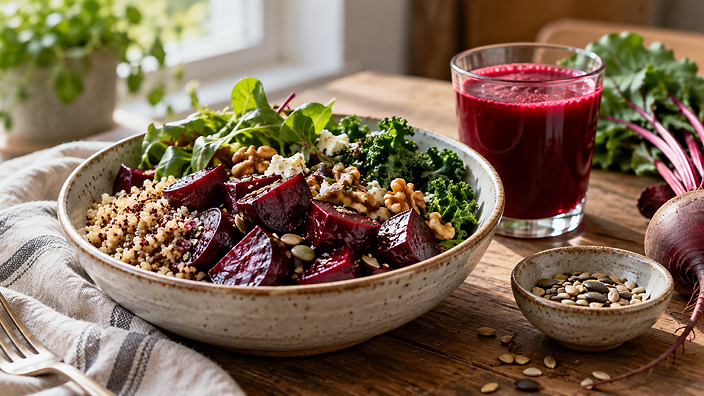
If you choose juice, compare serving sizes and check the Nutrition Facts panel for sugars, including any added sugars. If you choose a supplement, follow its directions and review the full label rather than combining products on the assumption that more is better.
There is no universal beetroot dose that can be recommended from this article for treating blood pressure, improving circulation, or increasing energy. Research preparations differ, and personal medical circumstances matter.
For blood pressure, discuss whether and how to monitor readings with your clinician. Use a record of measurements rather than a feeling of warmth or a single reading to judge a change.
Who should take extra care?
People with low blood pressure or taking blood-pressure medicines
Discuss concentrated beetroot products or large amounts of juice with your healthcare professional. Beetroot may lower blood pressure in some people, so your existing readings and medicines are relevant.
People with a history of calcium oxalate kidney stones
Beets contain oxalate. Whether you need to limit them depends on your stone type and individual advice.
NIDDK recommends tailoring dietary changes to the kind of kidney stone a person has had. A dietitian or clinician can help assess food choices and supplements without unnecessarily removing nutritious foods.
Anyone considering a blend
Bring the complete label to your medication review. An ingredient’s reputation does not establish the safety of a multi-ingredient formula, particularly when several supplements overlap. NCCIH recommends telling healthcare providers about all supplements you use or are considering.
People who notice digestive discomfort
Pay attention to tolerance. There is no reason to push through persistent stomach symptoms to continue a supplement. Stop and seek appropriate advice if symptoms develop.
Why beets can turn urine or stool pink
Beet pigments can temporarily change urine or stool color. This can be harmless after eating beets, but do not automatically assume every red discoloration is food-related.
If the change is unexplained, persists, appears to contain blood, or occurs with pain or other symptoms, contact a healthcare professional.
Common questions about beetroot
Are beetroot capsules as effective as juice?
They should not be assumed equivalent. Nitrate content, preparation, serving size, and product-specific evidence matter. Many studies used juice or concentrate rather than an ordinary beetroot capsule.
How quickly does beetroot work?
Some studies measure effects within hours; others assess repeated use over days or weeks. That does not establish a guaranteed onset for a commercial supplement. Follow the product directions rather than taking extra servings while waiting to feel something.
Can beetroot replace my blood-pressure medicine?
No. Continue prescribed treatment and discuss any proposed supplement with your clinician.
Does a higher beetroot milligram amount mean a stronger product?
Not necessarily. The total ingredient weight does not tell you the nitrate amount or establish better results.
Is a liquid formula better than capsules?
Convenience and preference may differ, but the research discussed here does not establish that a liquid blend is inherently better. Compare the complete formulas and serving information.
Choosing with confidence
Beetroot has a reasonable scientific basis for further research into blood pressure and endurance. Its strongest practical lesson is also a simple one: pay attention to the preparation, the measured outcome, and the limits of the evidence.
Enjoy it as food if you like it. If you prefer a supplement, compare the beetroot capsule formula and beetroot-containing liquid blend with your goals and medical circumstances in mind.
A useful choice begins with understanding what is in the serving—not just the promise on the front of the bottle.
This article is for general education and does not replace personal medical advice. Dietary supplements are not intended to diagnose, treat, cure, or prevent disease.
Sources and further reading
- Effects of beetroot juice on blood pressure in hypertension: systematic review and meta-analysis (2024)
- Health benefits of beetroot supplementation in older adults: systematic review (October 2026)
- Dietary nitrate improves vascular function in patients with hypercholesterolemia: randomized trial (2016)
- NIH ODS: Dietary Supplements for Exercise and Athletic Performance
- NCCIH: Hypertension (High Blood Pressure)
- NCCIH: Using Dietary Supplements Wisely
- NIDDK: Eating, Diet, & Nutrition for Kidney Stones
- Cleveland Clinic: Why Beets Turn Poop and Pee Red